Socially Distant Residency Project
May 16 - 17, 2020
Daniel Rotsztain is the Urban Geographer, an artist, writer, and cartographer whose work examines our relationships to the places we inhabit. As a geographer with European ancestry, Daniel’s projects engage with the responsibilities of settler-Canadians on Turtle Island. Alongside his art practice, Daniel is the co-lead of plazaPOPS, a community-lead initiative to transform private strip mall parking lots into accessible public spaces. His work has been featured in the Globe and Mail, the Toronto Star, Now Magazine, and he has a semi-regular column on CBC Radio’s Here and Now.
Residency Reflection
This conversation between Parker Kay and Daniel Rotsztain took place on July 23, 2020
PR: How many days/hours did you spend at Pumice Raft during your residency?
DR: thirty-six hours, over three days.
PR: Your experience was a bit different than the other three residents because a lot of your activity happened outside of Pumice Raft. How many hours do you think your two walks took you?
DR: In total the two walks took me fifteen hours and then an additional ten hours being in the psychic space of creating the maps.
PR: Could you describe the maps you made during your residency?
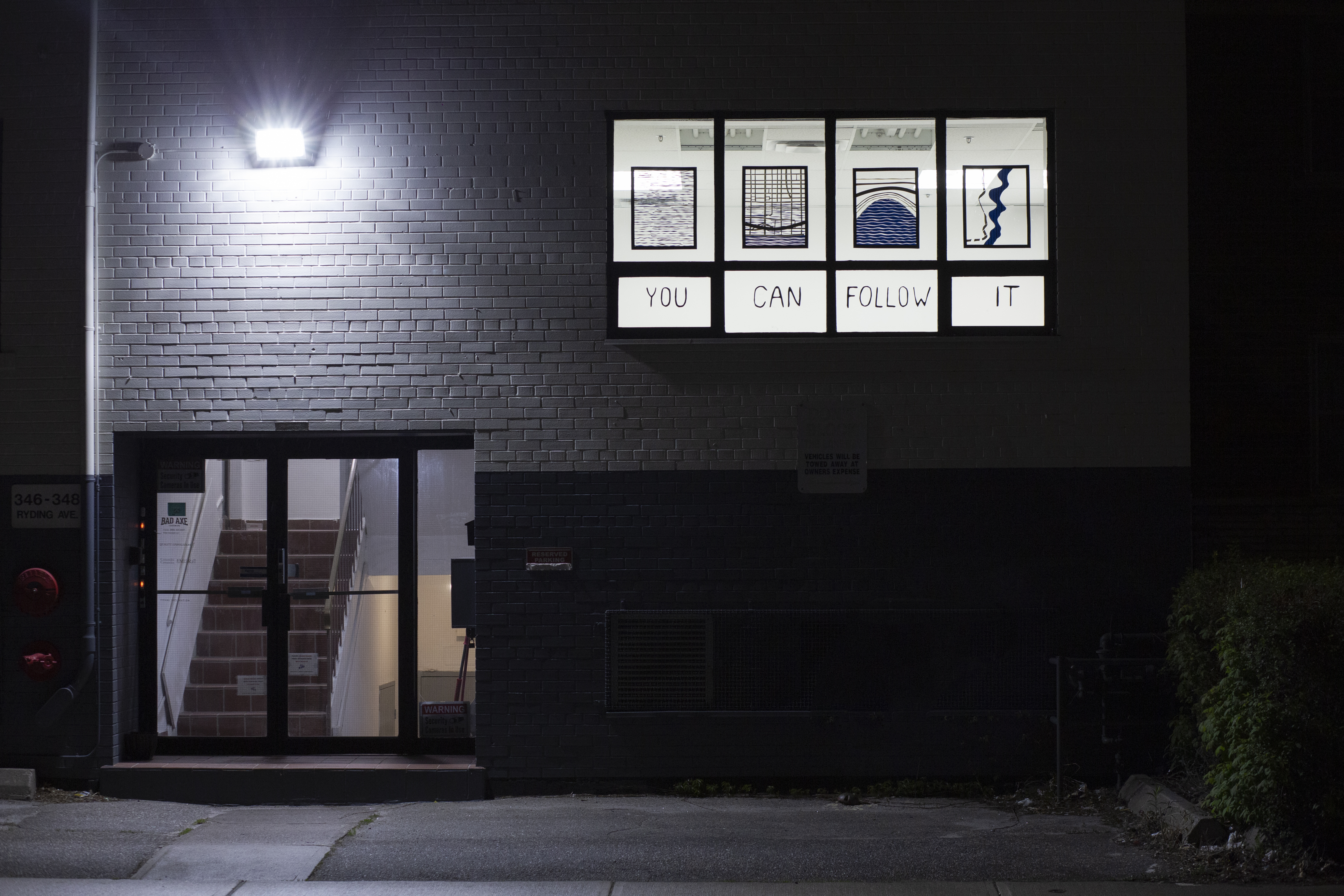
DR: The maps I made represented the walks that I took to Pumice Raft from my house on Toronto Island. Created with vinyl tape on windows, they were in response to a lot of the communications people were doing in the dead of lockdown -- through windows, like all those rainbows in support of front-line workers. For me, the window as a medium for communication at a time when we are not talking face-to-face was interesting.
I let the form of windows lead me both at Pumice Raft and at my house. At Pumice Raft there are four windows, so I divided my walk from Toronto Island to Pumice Raft into four sections. I wanted those four sections to describe water and my path in relation to this idea of following the historical paths along the former lakeshore and up the Toronto Carrying Place trail. In the four windows I wrote the text “you can follow it.” There is something about a window, and window communications, that makes me want to be big, exaggerated, and maybe a bit vague. I tend to not be vague in my artwork but there was something about the directness of this medium that I couldn’t put something too explicit as a message. The first section depicted water to represent me crossing the water on the [Toronto Island] ferry. The second [section] was tracing the original shoreline of Lake Ontario through downtown Toronto so it was about the confluence of the modern grid of streets in relation to where the water would have been and my attempt to follow it. The third was the arc of Humber Bay, which is very much where the shoreline was in the 1800’s and finally the fourth was following the Humber River itself via the Toronto Carrying Place Trail.
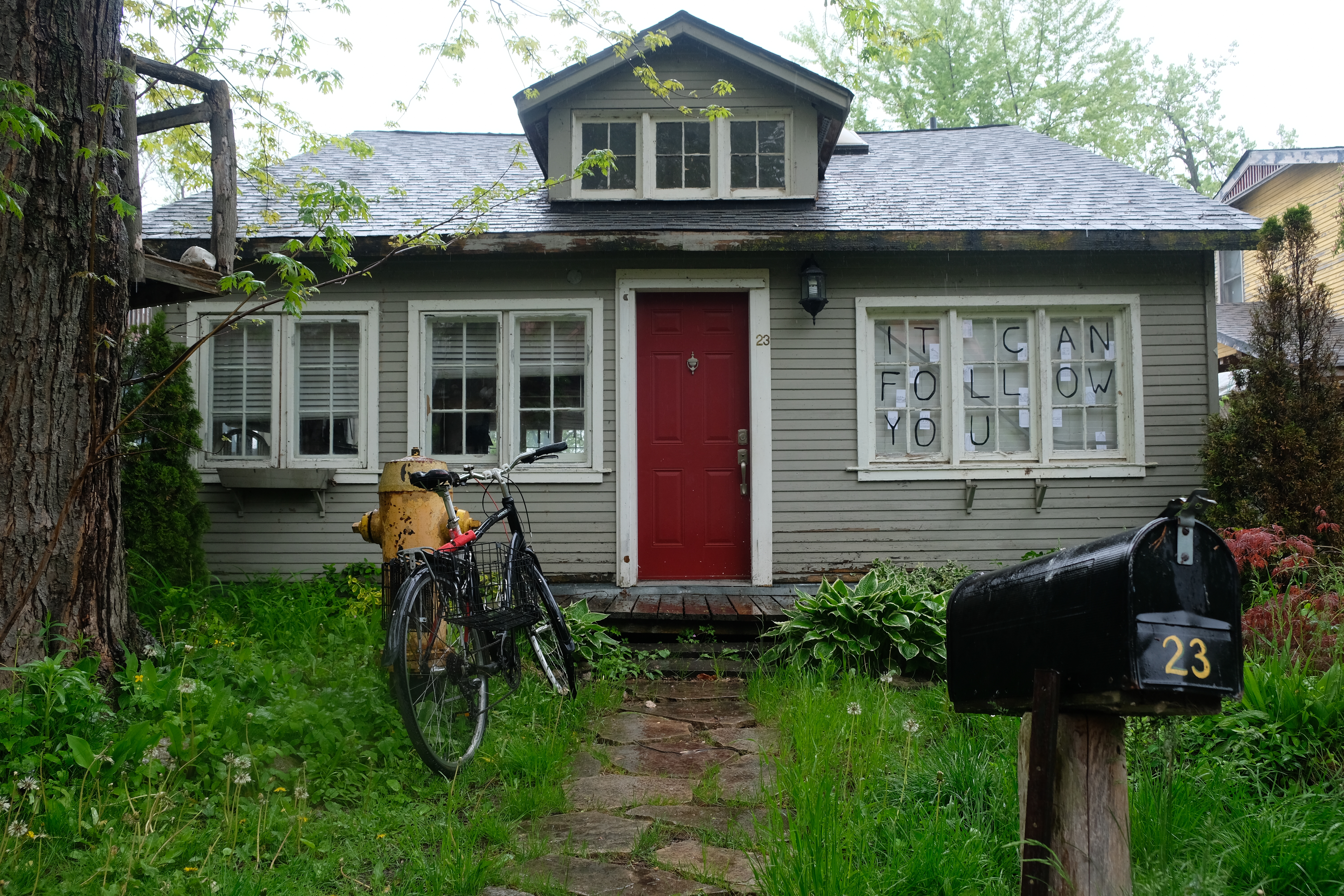
After walking to Pumice Raft tracing the original shoreline and the Humber River as an older form of communication I decided on my walk back I would trace the network of cell phone towers as a modern form of communication. For this walk I took a much more direct route and it took much less time. The map at my house on Toronto Island depicted the straightness of the route. I illustrated every cell phone tower that I passed and created a little illustration of each one using the aspect ratio of my cell phone, leaning into the theme of modern communications. The first walk I was following an established trail but -- I was following it -- and with the route back it -- the various cells that form the cellphone network -- was following me, which led to the accompanying text “it can follow you.”
PR: That’s really interesting because I’ve been thinking about how the qualities of urban space have the ability to augment the personal experience—the joy of exploration—while at the same time enabling top-down surveillance and control so it's nice how you acknowledged that dichotomy through your pair of walks. I think It is especially relevant, also, to recognize the presence of surveillance in cities in light of the civil unrest and protests that are happening in cities all over the world right now that are made possible by communication networks like, for example, cell phone towers.
DR: Yeah and that illustrates the way we think about cities and the way we don’t foreground certain things because of the fragmented nature of these technologies. Each walk was documented as a series of Instagram stories: there was a lot more response resonance on Instagram with my first walk along the shoreline and the Toronto Carrying Place Trail because I think Toronto sometimes has amnesia and people enjoy grasping onto lost history through a linear narrative. The cell phone tower walk, even though it is much more about the present and important to our current moment, it didn’t resonate as much. When you try and map these technologies they are intentionally fragmenting. If you look at the map of cell phone towers in Toronto it is so dense you can barely pick one tower from another. It seems that the things more pertinent to our lives are easier to ignore.
PR: There is an element to communication technology that feels like it is designed to be impenetrable. Within the way we frame communication there is a sense that it is ephemeral, consequence-free, and bears no weight in our lives. It is just a thing we use.
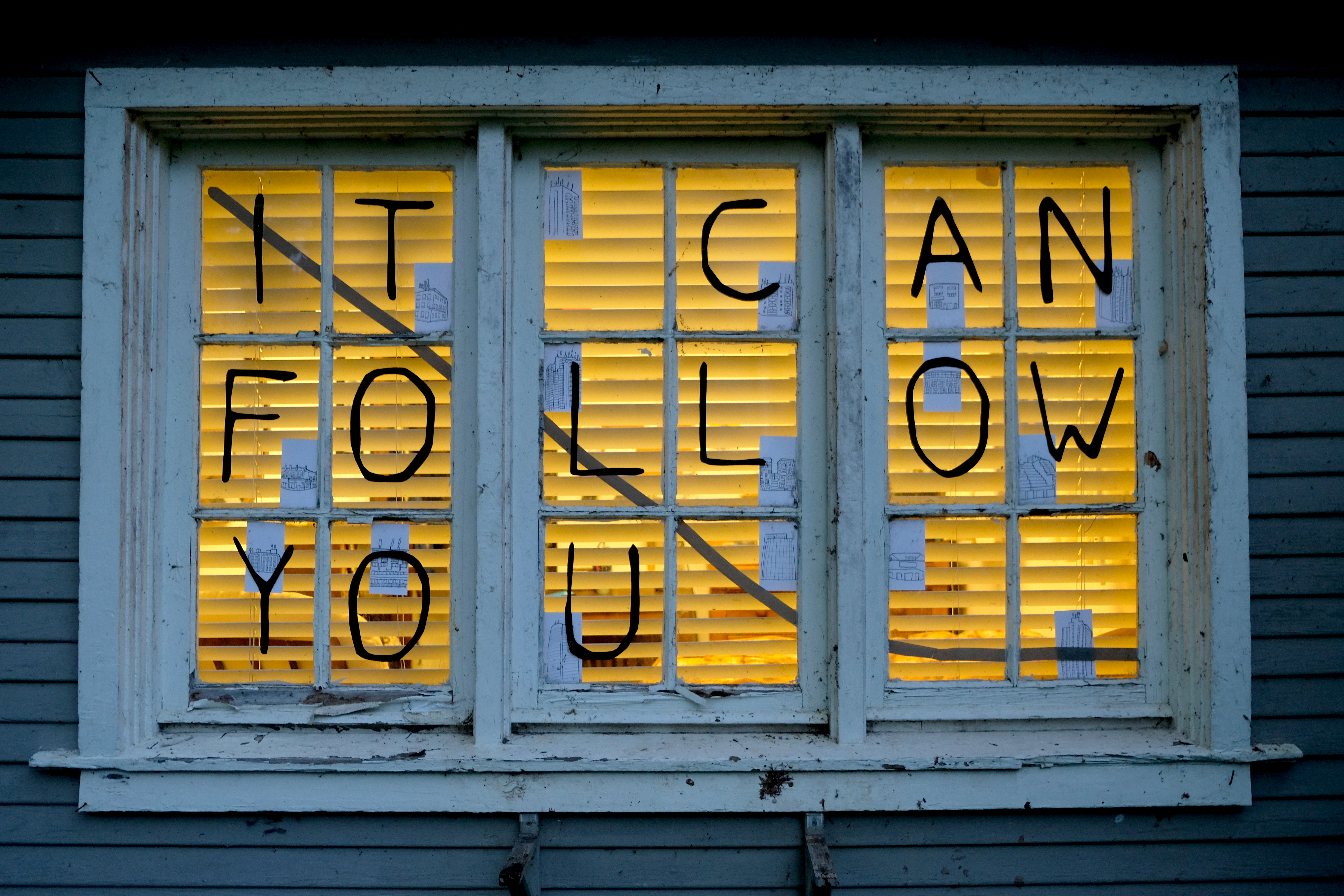
DR: Good design is invisible and you only notice something when it is broken. So you only notice the cell phone grid when there is an outage. As you walk through the city your phone travels through different “cells”, anchored by cell phone towers. This phenomenon of the seamlessness of the system -- even if you are taking the subway you could be passing through 70 cells -- you would never even notice it. In terms of them as a physical object in the urban landscape, a lot of them are stealth towers and are painted to blend in with the surrounding architecture. But they are also just so ubiquitous that you ignore them. Most of the companies don’t even attempt to hide them, but they are so everywhere that the totality of the system renders them invisible as well. Another funny crossover was at the time of the walk cell phone towers were in the news because of these COVID 5G conspiracies, which is not necessarily surveillance but these things remind us of the fact that we are—to varying degrees—tethered.
PR: It almost feels like the second walk has deeper resonances in hindsight. Your residency period (May 16-17, 2020) was five days before George Flloyd was murdered, which has since changed the world and the way we think about these notions of surveillance and control.
DR: Yeah, after the walks April Aliermo did a series of interviews (Part 1 and Part 2) with me on Instagram Live and I don’t think we could have had them, or if we did it would have been about a completely different set of topics, if they were scheduled only a few days later. I know that with surveillance and COVID there is also an intersection about concealing your identity and the mask as a symbol for that. As part of Vector Festival, which I had a piece in, they had an event around how to create a mask that bungles up security cameras and facial recognition while also protecting you and others from COVID-19 so yeah I think it is a rich time and I definitely think the project would have changed if it was on the other side of this.
PR: But it's interesting how it has changed on its own based on how we interpret it. Just going back to when you said communication networks render themselves invisible through their totality, to me there is a very clear parallel between that and white supremacy and how systemic oppression operates.
DR: Yes, exactly, a system’s power is in its totality.
PR: To pivot slightly, part of the idea with the residency project was to offer people the opportunity to change their state. During lockdown a lot of people were limited to occupying a single room for days or weeks on end, which in turn limits the possibility for the arc of experience to occur. In other words, our mental state changes are often dependent on moving between physical locations. I’m interested in how the physical space of Pumice Raft altered your mindset. Your experience is also unique because your time at Pumice Raft was preceded and succeeded by these physical odysseys. How did these corporeal experiences affect your mental state of mind?
DR: One of the phenomena that I’ve enjoyed experiencing and seen other people experience is how our radii have been severely limited especially if you don't have a car or bike. Transit was a non-option for a lot of people at the beginning of COVID so it wasn’t just the room but also the small radius that one could walk on foot. The positives of that are that people were starting to get to know their neighbours and immediate communities. My social media was full of people making these little local discoveries and it was like “everyone is an urban geographer now!” [laughs] So I think about the room but also the bubble around it and it was really refreshing to see the entire city through my walk to Pumice Raft and back. During the very short period of time that I was at Pumice Raft between the two walks my mind was full of the outside world. Even the experience of walking the shoreline and Toronto Carrying Place Trail versus the cell phone towers, the first walk was very grounding. I was looking at every plant, noting every footstep I took, and every person I saw, I was taking my time, and it was an exercise in doubling down on the land. You know, part of my identity and art practice is about asking what are the settler’s responsibilities towards the treaties and wampum belts and I know that part of that is getting to know where we are and not erasing, not thinking Toronto is a garbage dump but finding the beauty in it and finding its histories, in this case the Indigenous portage route that established Toronto as a meeting place. It was very slow and my perception of time was expansive and meditative.
The second walk I was cutting through the city diagonally on a grid. The first walk I was using a paper map and on the second walk I was punching in GPS coordinates of the next cell phone tower on Google Maps. I made myself follow the algorithm. Usually I’m like, “fuck you Google, I’m taking another route!” But this time I held myself to following the algorithm in the spirit of the cell phone towers and yielded to the power of technology. That whole walk felt like an hour. I slid through the city somewhat frictionlessly. It was a rainy afternoon on a long weekend and there was no one on the streets. In many ways the two walks together were a very symmetrical experience. Each walk was an extreme in the opposite direction, both literally and in terms of the quality of experience.
PR: When you described filling your mind up with the outside world and then the subsequent download at Pumice Raft it made me think of a camera obscura. You have the world being focused into a small lens and then projected into a box.
DR: Exactly, in the case of Pumice Raft you have the window map becoming the final projection backlit by the gallery’s lights when seen from the street at night.
PR: Throughout your limited time actually inside the gallery, how did that space imprint itself onto you?
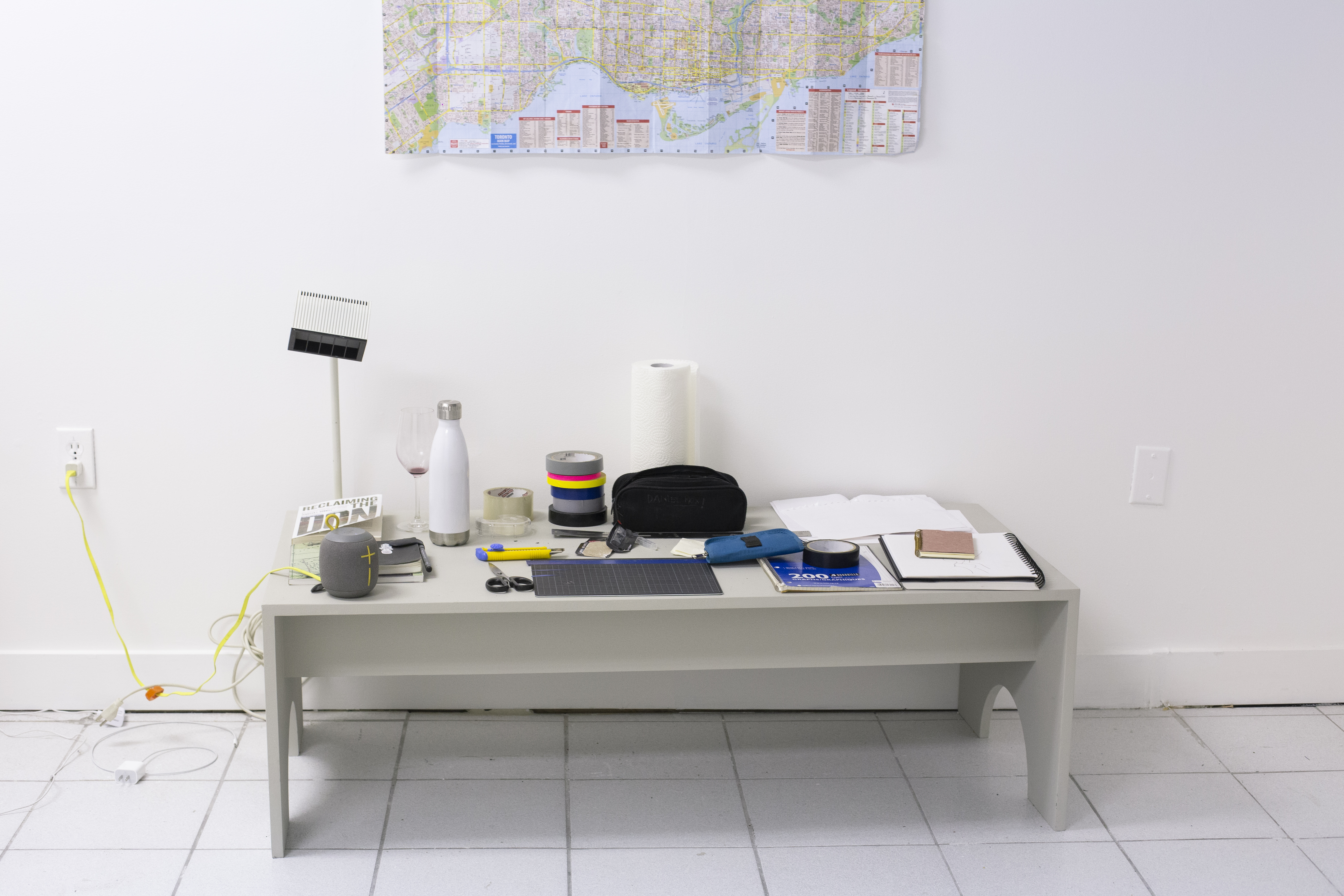
DR: I would say there is something to the simplicity of that space. It is almost a square. It is very symmetrical. It is in the spirit of the artworld—a white cube gallery—that is very much in contrast to my home which is full of my books, clothes, and all of my junk. It really felt like it was a container waiting to receive my activity and I think the simplicity of it helped streamline my process. I got there after my walk and needed to rest so I layed down for a while, staring at the ceiling and out the window, and taking in the stillness. But I think what the dimensions and simplicity of the room did was really help me concentrate. Also the fact that the windows are somewhat raised and not at ground level made me feel, in a funny way, very connected to the goings on along Ryding Avenue but also not being able to communicate with anybody. It felt like an echo of my walk which... I don’t want to seal myself off from the world while I’m doing these peripatetic drifting walks but I am in a different state of consciousness when I’ve prepared to do something like this and that relationship continued even once I was inside Pumice Raft. I was with the world but not with it.
PR: What changed in terms of your expectations or assumptions about how it would feel to do these walks and residency compared to after you had done it?
DR: Well it’s funny because I dream in space. I’m very spatially minded, and I imagined Pumice Raft, I really drew it out in my mind so the interface between the expectation of a project you’re dreaming up and then being on the other side of it and knowing it are still connected but also remain distinct as two separate spaces. I can still conjure up the Pumice Raft of my imagination and they both still exist, which is something I like about planning a project, there is a lot of imaginative energy in that process. In terms of my output, I really yielded to the process of doing the walks from point A to point B. I’m a bad traveller, I can’t just go to a random city and conjure up meaning, I do need points of significance so I do think the form of the residency was really rich. It is a point in space, you’re following a path to get to it, but everything else can fill in the blanks.
PR: Last question, I’ve received so much positive feedback about the stories you posted on Instagram chronicling your walks, I’m curious why you think in a time of isolation and social distancing why people excited to consume and follow this type of urban exploration through screens and devices as opposed to going out and finding it themselves.
DR: I think geography is a skillset and people need pointers. Anybody can go outside and see what is around them, and I think we did see that during COVID, but yeah the city is a confounding place and I think if you are busy with something else, taking care of somebody, taking care of something, taking care of your house, the city is so much to perceive and make sense of so I’m so grateful that my art practice can do that for people because it is a passion of mine. People really seem to appreciate a translation of the city and really enjoy seeing a version of themselves represented in the city because I think things resonate with people when they have a stake in it. So to see the city that you know, and places you know, and then information you don’t know, I think is a very rich experience in seeing yourself represented.
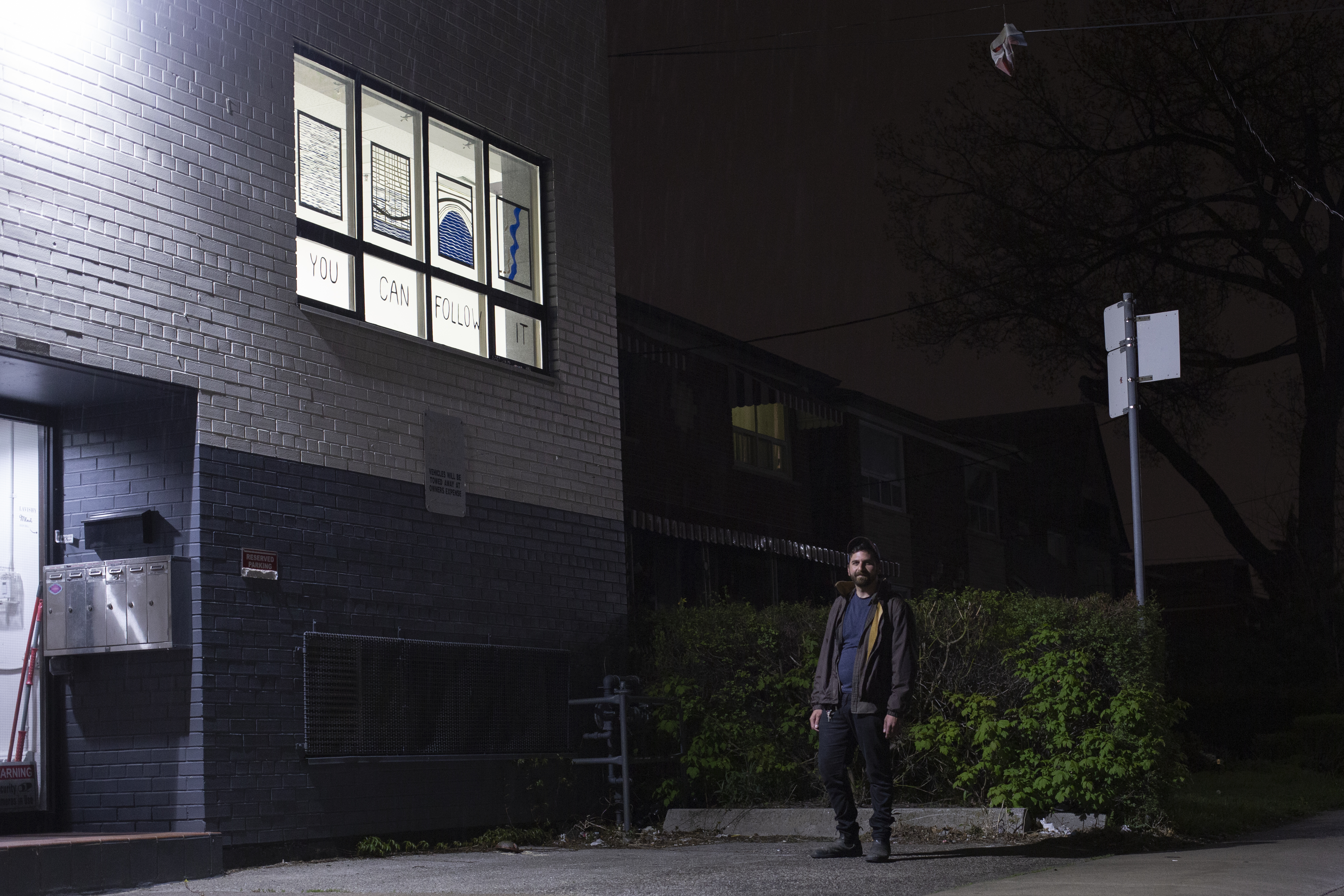
Images courtesy of Daniel Rotsztain and Natalie Logan